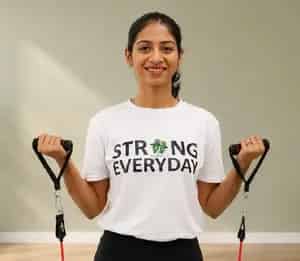
Free online fitness classes are the easiest way to find out whether a daily workout habit can fit into your life. You pay nothing, you train from home, and you get two full weeks to see how your body and your routine respond.
But a free trial only works if you use it well. Many people sign up, attend two classes, miss a day and never return. This guide shows you how to plan your 14 days, avoid the common mistakes, and decide honestly at the end whether to continue.
One free class tells you what a workout looks like. It doesn't tell you whether you will keep doing it.
Habits take repetition. In the first few days, everything is new: the moves, the pace, the time of day. By the second week, the warm-up feels familiar, your body has adapted a little, and showing up starts to feel normal. That is the point at which you can judge whether the classes suit you.
A 14-day trial also gives you room for real life. You will probably have a busy day, a late night or a sore morning in those two weeks. Learning to get back the next day is part of what the trial teaches you.
- •Choose one slot you can protect every day, and treat it like an appointment.
- •Set two alarms: one 15 minutes before class to change and set up, and one at the start time.
- •Clear a space where you can stretch your arms out and step forward and back.
- •Keep a mat, water and a small towel in that spot so setup takes one minute.
- •Tell your family when your class is, so you are not interrupted.
- •Note your starting point: how stairs feel, how easily you get up from the floor, your energy in the afternoon. You will compare these on day 14.
Your only goal is to learn the format. Watch each demonstration before you move, choose the easier option for every exercise, and rest whenever you need to. Finishing the class matters more than how hard you work.
Mild muscle soreness in the first week is normal, especially in the thighs, glutes and shoulders. It usually eases as your body adapts. Light movement helps more than rest, so attending the next class at an easier pace is often the best thing you can do. Sharp or joint pain is different: stop and check with a doctor.
By now, some exercises will feel comfortable. Pick one or two and try the harder variation. Keep everything else the same. Small, steady progress is how strength builds safely.
Pay attention to everyday life rather than the mirror. Do stairs feel easier? Do you get up from the floor with less effort? Do you have more energy after lunch? These small shifts are the first signs that regular strength training is working.
- •Going too hard on day one. Doing the harder version of everything leads to heavy soreness and a skipped day two. Start easy.
- •Treating one missed day as failure. Missing a class is normal. The habit breaks only when one missed day becomes three. Come back the next day.
- •Choosing an unrealistic slot. A 6:30 AM class is great only if you can wake up for it. If a slot keeps clashing with your day, switch to one that doesn't.
- •Comparing yourself with others. Everyone starts at a different level. Your only benchmark is where you were on day one.
- •Expecting fast visible results. Two weeks is about habit and how you feel, not dramatic body changes.
- 1.Attendance: did you attend at least 10 of the 14 days? If yes, the routine fits your life.
- 2.Ease: do the easier variations now feel comfortable?
- 3.Daily life: compare stairs, getting up and afternoon energy with your notes from before day one.
- 4.Enjoyment: did you look forward to class on at least some days?
- 5.Timing: do you know which slot works best for you?
If you answered yes to most of these, you have built the start of a habit worth continuing. If not, think about what got in the way. Often it is the slot, not the workout.
Free workout videos are everywhere, so why use a free trial of structured classes? Videos tend to jump between styles, trainers and levels, so you start over every time you pick a new one. A structured trial follows the same warm-up, strength and stretch format every day, so the moves become familiar and you can actually measure your progress over two weeks.
A trial also has a clear end point. Day 14 forces a decision, which gives the two weeks a purpose that an endless playlist never has.
This article is for general information only and is not medical advice. Please consult a doctor before starting any new exercise routine, especially if you have a health condition, an injury or are pregnant.